 General
Ben Thanh Market: Vietnam's Iconic Food and Goods Hub
Ben Thanh Market Ho Chi Minh City: Vietnam's Iconic Food and Goods Marketplace Guide
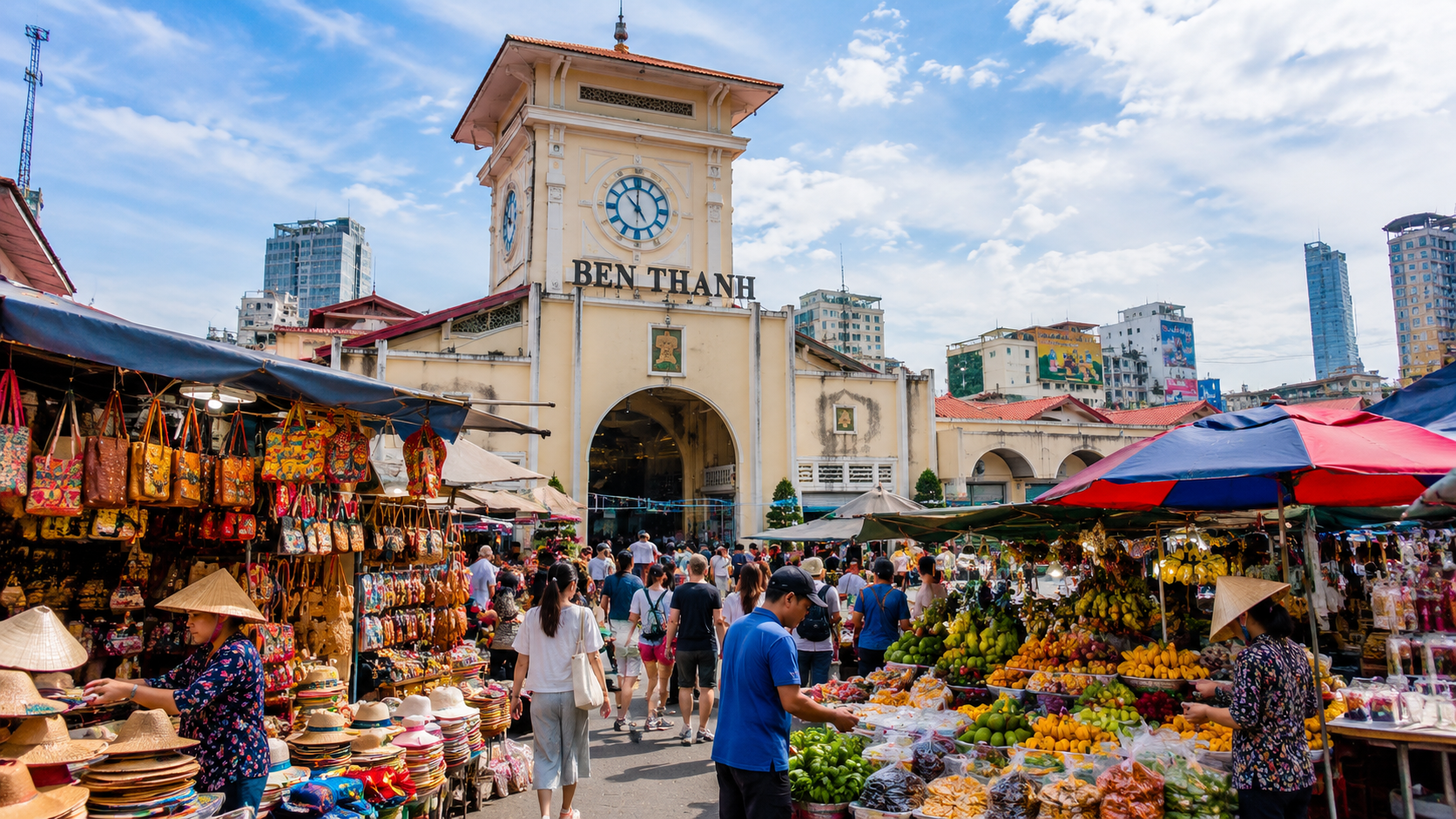
Ben Thanh Market stands at the commercial heart of Ho Chi Minh City, a sprawling indoor bazaar that has become as synonymous with Vietnam's largest metropolis as the Notre-Dame Cathedral Basilica or the Reunification Palace. For traders, wholesalers, and curious travelers arriving from Singapore, Dubai, London, New York, Shanghai, Lagos, Nairobi, Mumbai, or Berlin, the market represents far more than a tourist photo opportunity. It is a living economic organism where food stalls, textile vendors, handicraft sellers, and household goods merchants operate side by side under a single colonial-era roof, generating daily turnover that ripples through supply chains reaching the Mekong Delta, the Central Highlands, and international export corridors.
The market occupies a prime block in District 1, bounded by Le Loi, Ham Nghi, Tran Hung Dao, and Le Lai streets, a location that places it within walking distance of the backpacker enclave on Pham Ngu Lao, the financial towers along Nguyen Hue, and the riverfront developments of the Saigon River. This geographic centrality matters for global business audiences because it illustrates how traditional marketplaces continue to anchor urban commercial ecosystems even as e-commerce platforms and modern retail chains expand. Ben Thanh functions simultaneously as a retail destination for local residents, a wholesale node for small traders, a culinary landmark for international visitors, and a cultural symbol deployed in tourism marketing campaigns across Asia.

Understanding Ben Thanh requires looking beyond the postcard image of conical hats and steaming pho bowls. The market is a complex institution shaped by French colonial urban planning, post-war socialist reorganization, doi moi economic reforms, and contemporary tourism economics. Its roughly 3,000 stalls and thousands of daily transactions make it a barometer for consumer sentiment in southern Vietnam. For international buyers sourcing textiles, coffee, cashew nuts, or lacquerware, the market offers a low-friction entry point to Vietnamese suppliers, though it also presents challenges related to price negotiation, quality consistency, and counterfeit goods that require careful navigation.
Historical Background and Context
The origins of Ben Thanh trace back to the early seventeenth century, when a informal market formed near the Saigon River close to a wharf used by traders arriving from surrounding provinces. The name Ben Thanh combines the Vietnamese words for wharf and citadel, reflecting its position beside a landing stage and near a military fortification. As Saigon grew under Nguyen dynasty rule and later under French colonial administration, the market evolved from an open-air gathering of boats and stalls into a structured commercial district. The French authorities demolished an earlier market structure in the late nineteenth century and rebuilt it, eventually constructing the current building between 1912 and 1914 after a fire destroyed its predecessor.
The colonial-era building features a distinctive clock tower at its southern entrance, a design element that has become the market's visual signature. Architecturally, the structure blends French planning sensibilities with local climate adaptation, using high ceilings and ventilation channels to manage tropical heat. During the Vietnam War era, the market area witnessed significant disruption, and in the post-1975 period, the new socialist government reorganized trading activities under cooperative models. Many vendors operated under state-sanctioned frameworks, and private trading faced restrictions that altered the market's commercial character.
The doi moi reforms introduced in 1986 gradually liberalized Vietnam's economy, allowing private enterprise to flourish again. Ben Thanh re-emerged as a hub for independent traders, family businesses, and regional suppliers. Through the 1990s and 2000s, as Vietnam integrated into global trade through WTO accession in 2007 and successive free trade agreements, the market's vendor base diversified. Today, the market operates under the management of the Ben Thanh Market Management Board, a municipal entity responsible for stall allocation, sanitation, fire safety, and fee collection. The surrounding area has also transformed, with Ben Thanh Market becoming a stop on the Ho Chi Minh City Metro Line 1, which opened in late 2024 and connects the city center to Suoi Tien in Thu Duc City, further embedding the market in modern urban mobility networks.
Key Features and Offerings
The market's interior is organized into distinct zones that reflect the diversity of Vietnamese consumer goods. The food section, concentrated toward the rear and side corridors, offers dried seafood, spices, coffee beans, cashew nuts, tropical fruits, and prepared dishes served at communal tables. Vendors sell robusta and arabica coffee from the Central Highlands, fish sauce from Phu Quoc, rice paper from Tay Ninh, and confectionery items such as coconut candy from Ben Tre. For international food importers, this section provides direct exposure to Vietnamese specialty products, though export-grade volumes typically require sourcing through specialized consolidators rather than individual stalls.
Textile and apparel stalls dominate a large portion of the market, offering ready-made garments, ao dai tunics, silk scarves, and fabric by the meter. Many vendors maintain relationships with garment factories in Ho Chi Minh City and surrounding provinces, allowing them to offer competitive pricing on bulk orders. Handicraft sections feature lacquerware, bamboo products, embroidered linens, and ceramic goods, with some stalls specializing in products from craft villages such as Bat Trang and Chu Dau. Household goods, kitchenware, footwear, luggage, and electronics accessories fill additional corridors, creating a comprehensive one-stop shopping environment that mirrors the merchandise mix found in markets from Dubai's Gold Souk to Mumbai's Crawford Market.
Food is central to the Ben Thanh experience. The market's cooked food stalls serve pho, bun bo Hue, banh xeo, broken rice plates, and fresh spring rolls to thousands of customers daily. The market opens early, with food vendors active from around 6 a.m., and transitions to a night market format in the evening when surrounding streets close to traffic and additional stalls appear outdoors. This dual-day structure extends operating hours and captures both local breakfast trade and tourist evening spending. For global food and beverage businesses, the market illustrates how traditional street food culture can coexist with formal retail, a dynamic observable in Singapore's hawker centers and Bangkok's Chatuchak Weekend Market.
Price negotiation remains standard practice for non-food items, with initial quotes often inflated for tourist customers. Vendors typically accept cash in Vietnamese dong, and some accept U.S. dollars, though exchange rates vary. Bargaining is expected, and successful transactions often settle at 50 to 70 percent of the initial asking price, depending on the vendor, product category, and customer fluency. Food stalls generally operate on fixed pricing, reflecting thinner margins and higher turnover. The market's layout, with narrow aisles and dense stall clustering, creates an intense sensory environment that experienced buyers navigate efficiently while first-time visitors often find overwhelming.
economic impact and global relevance
Ben Thanh Market contributes meaningfully to Ho Chi Minh City's economy through direct employment, tax revenue, and tourism spending. The market supports thousands of vendor families and indirect employment in logistics, food supply, cleaning, and security. Municipal authorities collect stall rental fees and market service charges, though informal estimates suggest that a significant portion of transactions occur outside formal accounting channels. For Vietnam's broader economy, the market serves as a showcase for small and medium enterprise activity, a sector that accounts for roughly 40 percent of GDP and employs a majority of the workforce.
Tourism is a major economic driver. Ho Chi Minh City welcomed over 5 million international visitors in 2024, and Ben Thanh Market consistently ranks among the most visited attractions in the city. Tourist spending at the market supports not only vendors but also surrounding hotels, restaurants, and transport services. The market's reputation draws visitors from across Asia, Europe, and North America, with notable volumes from South Korea, Japan, China, Australia, and the United States. For destination marketing organizations, Ben Thanh functions as a brand asset that communicates authenticity, culinary richness, and commercial vitality.
From a global trade perspective, the market offers lessons in how traditional bazaars integrate with modern supply chains. Many vendors source from wholesale markets such as Binh Tay in Cholon or directly from factories and craft villages. Some maintain export relationships, shipping lacquerware to buyers in Europe or textiles to regional distributors. The market's proximity to Tan Son Nhat International Airport and the Saigon Port system facilitates logistics for larger orders. However, the market is not a primary export hub; it functions more as a retail and sampling environment where international buyers can assess product quality and establish contacts before scaling orders through formal channels.
Comparisons with other global marketplaces are instructive. Dubai's spice souk and gold souk cater heavily to tourism and regional re-export, while Singapore's retail landscape has largely displaced traditional wet markets into hawker centers and specialized districts. London's Borough Market has evolved into a premium food destination with strict vendor curation, and New York's Chelsea Market blends food retail with office and media tenants. Ben Thanh differs in its scale, density, and dual function as local necessity market and tourist attraction. Its closest analogues may be Istanbul's Grand Bazaar in terms of tourist-vendor dynamics or Bangkok's Chatuchak in terms of merchandise breadth, though Ben Thanh operates on a more compact footprint.
challenges and solutions
Ben Thanh Market faces structural and operational challenges that affect vendors, shoppers, and municipal authorities. Addressing these issues requires coordinated action across public and private stakeholders, drawing on practices observed in market modernization programs in Singapore, Seoul, and Barcelona.
| Challenge | Risk | Solution |
|---|---|---|
| Price inconsistency and tourist overcharging | Reputational damage, reduced repeat visits | Published price guidelines, vendor training, digital price boards |
| Counterfeit and low-quality goods | Brand erosion, customs seizures for export buyers | Vendor certification, origin labeling, quality inspection partnerships |
| Fire and safety hazards in dense stalls | Property damage, injury, business interruption | Regular inspections, electrical upgrades, sprinkler installation |
| Sanitation in food zones | Public health incidents, tourism decline | Daily audits, cold chain improvements, vendor hygiene certification |
| Competition from e-commerce and malls | Declining footfall, vendor turnover | Digital storefronts, delivery integration, experiential marketing |
| Traffic and pedestrian congestion | Accessibility issues, emergency response delays | Pedestrian zones, metro connectivity, parking management |
Price inconsistency remains a persistent complaint among international visitors. Vendors often quote higher prices to tourists, and the absence of posted prices for many goods creates friction. Municipal authorities and tourism boards have periodically introduced awareness campaigns and suggested pricing, but enforcement remains limited. Vendor training programs emphasizing transparent pricing and customer service could improve outcomes, following models used in Singapore's Chinatown Complex and Seoul's Namdaemun Market.
Counterfeit goods present risks for buyers seeking export-quality merchandise. Branded apparel, accessories, and electronics accessories sold at Ben Thanh may infringe trademarks, creating legal exposure for international buyers who import without verification. Establishing vendor certification schemes and origin labeling would help legitimate traders differentiate themselves. Fire safety is another critical concern given the density of stalls and electrical wiring; periodic upgrades and strict inspections are essential. Food sanitation requires continuous attention, particularly in the prepared food sections where cold chain management and water quality affect public health.
Competition from e-commerce platforms such as Shopee, Lazada, and TikTok Shop has altered consumer behavior in Vietnam, particularly among younger urban shoppers. Traditional markets must adapt by integrating digital payments, offering delivery services, and creating experiential value that online channels cannot replicate. The opening of Metro Line 1 presents an opportunity to attract more visitors and improve logistics, provided that station-to-market connectivity and pedestrian infrastructure are well designed.
Future Outlook
Ben Thanh Market's future depends on balancing heritage preservation with commercial modernization. The building holds cultural and architectural significance, and any renovation must respect its historical character while upgrading facilities to meet contemporary safety and accessibility standards. Municipal plans have discussed pedestrianization of surrounding streets, improved waste management, and digital infrastructure to support cashless payments and vendor e-commerce integration.
The metro connection is likely to reshape visitor flows and vendor economics. Improved accessibility may increase footfall from local residents who currently avoid the tourist-heavy market, potentially restoring some of the market's original function as a daily necessity destination. At the same time, rising tourism volumes could accelerate commercialization toward souvenirs and food experiences, further differentiating Ben Thanh from suburban wet markets such as Ba Chieu or Tan Dinh.
For international businesses, the market's evolution signals broader trends in Vietnam's retail sector. The country's middle class is expanding, e-commerce is growing rapidly, and consumers are becoming more quality-conscious. Traditional markets that adapt through vendor training, digital tools, and hygiene improvements can retain relevance. Those that resist change risk gradual decline, as seen in several older markets across Southeast Asia that have lost ground to malls and online platforms.
Sustainability is another emerging consideration. Food waste, plastic packaging, and energy consumption are gaining attention among vendors and municipal authorities. Initiatives to reduce single-use plastics, improve waste sorting, and source locally produced goods could align Ben Thanh with global sustainability expectations, particularly among European visitors and corporate buyers with environmental procurement policies.
Conclusion
Ben Thanh Market remains one of Southeast Asia's most significant traditional marketplaces, a commercial and cultural institution that connects Vietnamese producers, urban consumers, and international visitors. Its history reflects the broader arc of Vietnam's economic development, from colonial trade hub to socialist reorganization to market-oriented reform. Its present challenges, including price transparency, counterfeit goods, safety, and digital competition, mirror those faced by traditional markets worldwide, from Lagos's Balogun Market to Mumbai's Crawford Market and Nairobi's City Market.
For global traders and business audiences, Ben Thanh offers a practical entry point to Vietnamese consumer goods and a vivid illustration of how traditional retail ecosystems operate alongside modern commerce. The market's future will depend on thoughtful modernization that preserves its character while addressing operational weaknesses. As Ho Chi Minh City continues to integrate into global supply chains and tourism networks, Ben Thanh will remain a bellwether for how heritage commerce adapts to contemporary economic pressures.
Put Your Brand Where Customers Are Already Searching
building a sustainable brand is only part of the job. Customers also need a convenient place to discover your products and services. TradeBasin provides businesses worldwide with an online marketplace where sellers can present products and services to buyers locally and internationally.
LIST YOUR BUSINESS OR PRODUCTS ON TRADEBASIN


