 General
Computer Village Ikeja: Nigeria's Tech Trading Powerhouse
Inside Computer Village Ikeja: Nigeria's Premier Technology and Gadgets Trading Hub
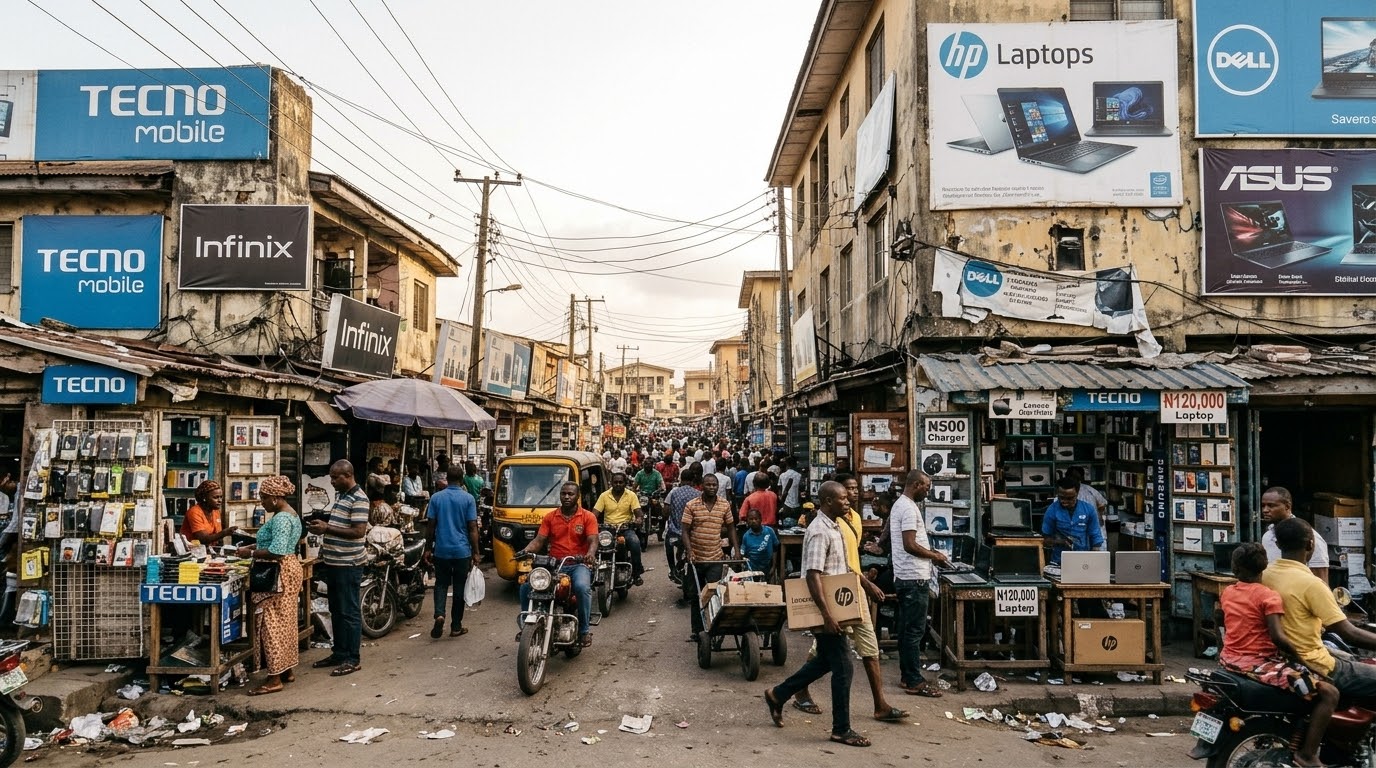
In the dense commercial sprawl of Ikeja, the capital of Lagos State, sits a market that has become synonymous with technology commerce across West Africa. Computer Village Ikeja, formally known as the Ikeja Computer Village, is widely regarded as the largest information and communications technology (ICT) accessory market in Africa and one of the most concentrated electronics trading clusters anywhere in the developing world. Stretching across a network of streets anchored by Otigba, Pepple, Ola-Ayeni and Adepele, the market hosts thousands of businesses operating from shops, stalls, kiosks and multi-storey plazas. It is where a first-time smartphone buyer, a corporate IT procurement officer, a refurbisher, a software developer and a foreign sourcing agent can all find something relevant within a few hundred metres of one another.
The market's reputation rests on volume, variety and speed. Traders deal in new and fairly-used laptops, smartphones, tablets, printers, networking equipment, CCTV hardware, power accessories, gaming peripherals and an enormous range of components and spare parts. Repairs are a core activity, with technicians specialising in board-level phone repairs, laptop screen replacements, data recovery and software installation. For global audiences accustomed to structured retail environments such as Dubai's Dragon Mart, Singapore's Sim Lim Square, London's Tottenham Court Road corridor or Shanghai's Huaqiangbei electronics district, Computer Village offers a comparable density of technology commerce, but with a distinctly West African character defined by informality, negotiation and entrepreneurial energy.

Understanding Computer Village matters far beyond Lagos. It functions as a distribution gateway for imported technology into Nigeria and neighbouring markets, a price-discovery mechanism for devices and parts, and an employment engine for tens of thousands of people. It also illustrates how emerging-market technology clusters organise themselves when formal retail infrastructure is limited, and how those clusters adapt to currency volatility, import regulation and the shift toward e-commerce. This article examines the market's origins, its offerings, its economic weight, its structural challenges and the forces likely to shape its next chapter.
Historical Background and Context
Computer Village grew from modest beginnings in the 1990s, a period when Nigeria began opening its economy and when personal computing was moving from government and corporate offices into small businesses and homes. Early traders clustered around Otigba Street in Ikeja, initially selling typewriters, calculators, office equipment and basic computer peripherals. As demand for personal computers expanded through the late 1990s and early 2000s, the cluster attracted more vendors, technicians and importers, and the market's identity shifted decisively toward ICT. The name "Computer Village" became both a physical address and a brand recognised across the country.
Several forces drove that growth. Nigeria's population and urbanisation created a vast consumer base hungry for connectivity. The liberalisation of telecommunications and the explosive growth of mobile networks from the early 2000s onward turned phones into mass-market products, and Computer Village became the country's most visible phone trading floor. Deregulation and subsequent consolidation in the banking sector increased access to trade finance and point-of-sale infrastructure, enabling more traders to operate at scale. Meanwhile, global manufacturing shifts in Asia, particularly in China, Taiwan, South Korea and later Vietnam, produced a deep supply of affordable devices and components that Nigerian importers could channel into the market.
The market's governance evolved alongside its commerce. The Computer and Allied Products Dealers Association of Nigeria (CAPDAN) emerged as the principal trade association representing dealers, negotiating with government agencies and seeking to impose order on the cluster. The Lagos State Government has repeatedly intervened on infrastructure, traffic management, sanitation and, most contentiously, relocation. Proposals to move the market to a purpose-built ICT park in Katangowa, on the outskirts of Lagos, have circulated for years, generating debate between those who see relocation as necessary modernisation and those who argue that the market's success depends on its central Ikeja location and the customer flows it generates.
The historical arc of Computer Village mirrors patterns seen in other emerging-market electronics clusters. Huaqiangbei in Shenzhen began as a collection of small stalls and became a global sourcing destination. Nairobi's Ngara and River Road electronics corridors, Accra's Circle area and Mumbai's Lamington Road followed similar trajectories of organic clustering, specialisation and gradual formalisation. What distinguishes Computer Village is its scale relative to Nigeria's population and its role as the primary gateway for technology imports into Africa's largest economy. Its history is therefore not merely local; it is a case study in how informal trade clusters become strategic national assets.
Key Features and Offerings
The breadth of goods and services available in Computer Village is its defining feature. On the hardware side, the market covers the full consumer electronics spectrum: smartphones from global brands and a wide array of Chinese and lesser-known manufacturers, laptops and desktops, monitors, printers, scanners, projectors, routers, switches, servers and storage devices, CCTV cameras and access-control systems, power banks, inverters, solar components and generators. Components are sold separately, which matters enormously in a market where repair rather than replacement is often the default. Screens, batteries, keyboards, motherboards, RAM modules, chargers, cables and connectors are available in configurations that range from original manufacturer parts to aftermarket equivalents.
Software and services form a second pillar. Traders and technicians install operating systems, productivity suites, antivirus software and specialised applications. They unlock devices, recover data, configure networks and set up small-office IT systems. Some businesses offer graphic design, web development, point-of-sale deployment and digital marketing services. Training is another component, with informal apprenticeships and short courses in hardware repair and software skills operating alongside the trading activity. This service layer distinguishes Computer Village from a pure commodity market and helps explain its resilience: customers come not only to buy devices but to have them fixed, configured and supported.
The market's structure is highly segmented. Certain streets and plazas specialise in phones, others in laptops, printers, accessories or repairs. This specialisation creates efficiency, because a buyer can compare dozens of vendors offering the same category within minutes. It also creates a dense ecosystem of intermediaries: importers, wholesalers, retailers, technicians, couriers, money changers, food vendors, transporters and informal financiers. The result is a self-contained commercial organism that processes enormous transaction volumes daily.
For international buyers and sourcing agents, Computer Village offers access to used and refurbished devices that are scarce or uneconomical to source elsewhere. Nigeria's large second-hand electronics market, fed by trade-in schemes, corporate disposals and imports, makes the cluster relevant to refurbishers and parts harvesters across the region. At the same time, the market's retail-facing character means that bulk buyers must navigate fragmented supply, variable quality and limited standardisation. Experienced sourcing agents often maintain relationships with specific trusted dealers rather than relying on anonymous transactions, a pattern familiar to buyers operating in Dubai's Deira markets, Bangkok's Pantip Plaza or Lagos's own Alaba International Market.
economic impact and global Relevance
The economic footprint of Computer Village is substantial. Estimates of the number of businesses operating in and around the cluster run into the thousands, with direct employment spanning traders, technicians, apprentices, support staff and logistics workers. Indirect employment extends to suppliers, transporters, food vendors, security personnel and financial service providers. For many young Nigerians, the market is an entry point into technology careers: an apprentice who learns board-level phone repair can later establish an independent workshop, and a stall holder who builds a customer base can graduate into wholesale importation.
The market's role in national trade is equally significant. Nigeria imports the overwhelming majority of its electronics, and Computer Village functions as a primary distribution node through which goods flow to retailers in other states and to neighbouring countries. Price signals generated in the market influence retail pricing nationwide, and the cluster's demand for components and accessories supports supply chains stretching back to factories in Shenzhen, Guangzhou, Hong Kong, Taipei and Seoul. In this sense, Computer Village is a visible endpoint of global manufacturing networks, connecting African consumer demand to Asian production in a way that parallels how Singapore's Sim Lim Square and Dubai's electronics souks connect regional demand to global supply.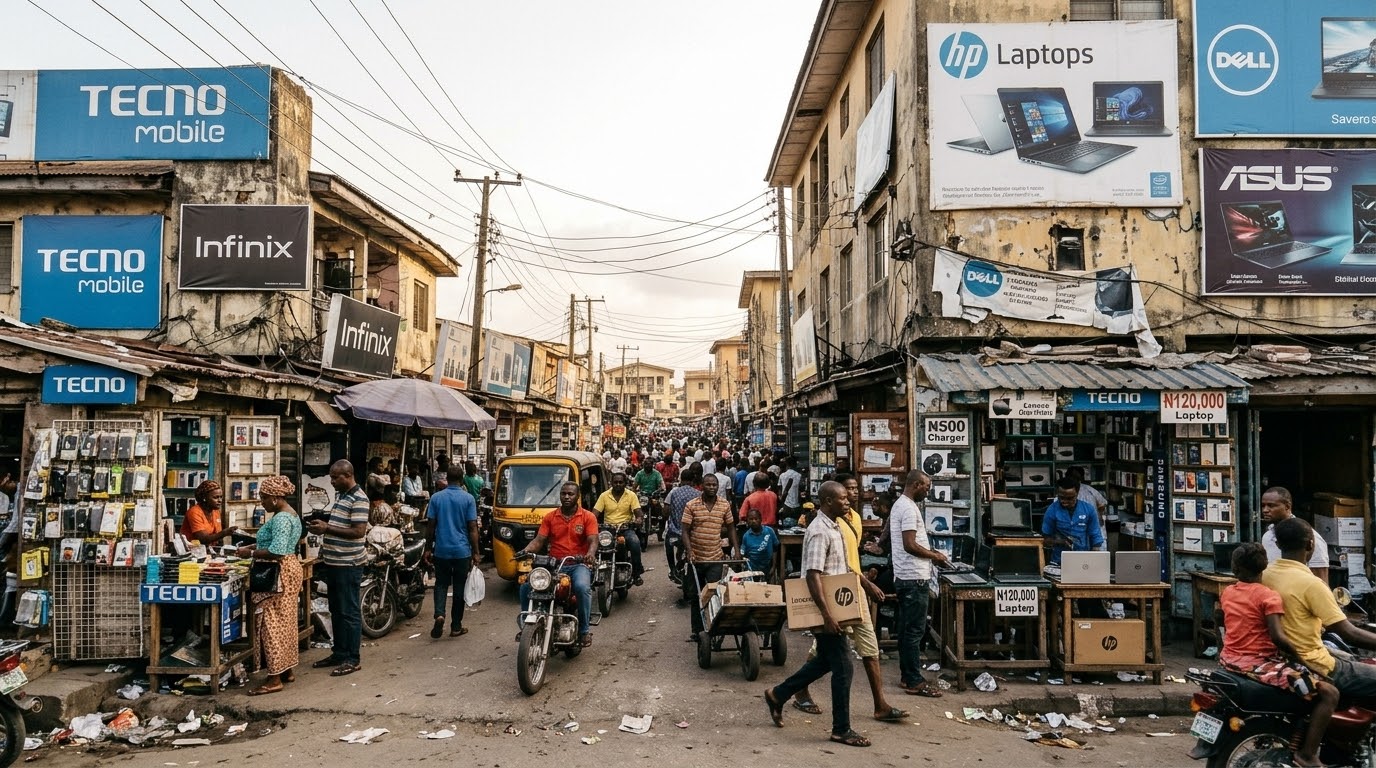
Global relevance also flows through the diaspora and through cross-border commerce. Nigerian diaspora communities in London, Houston, Toronto and Johannesburg source devices and parts through family and business networks anchored in the market. West African traders from Ghana, Benin, Cameroon and beyond travel to Lagos to buy stock, making Computer Village a regional wholesale hub. Remittance flows and informal trade finance lubricate these transactions, and the market's money-changing and payment ecosystems reflect the multicurrency reality of West African commerce.
The cluster also matters to the broader debate about industrial policy and digital economy development in Africa. Computer Village demonstrates that technology value can be captured not only through manufacturing but through distribution, repair, refurbishment and services. As circular-economy thinking gains traction globally, the market's extensive repair and reuse ecosystem positions it as an accidental pioneer in extending device lifespans. Policymakers in Nairobi, Accra and Kigali study Lagos's cluster model when designing their own ICT hubs. International organisations focused on digital inclusion and small-business finance cite markets like Computer Village as critical last-mile infrastructure for affordable technology access.
challenges and solutions
Computer Village's strengths are inseparable from its vulnerabilities. The cluster's density, informality and dependence on imports expose it to shocks that more formal retail systems can absorb. Currency volatility is a persistent challenge: as the naira has fluctuated against the dollar, importers' costs have swung sharply, forcing frequent repricing and squeezing margins. Import regulation, including customs valuation disputes and periodic restrictions on certain categories, adds uncertainty. Counterfeit and substandard goods, a problem common to electronics markets worldwide, damage trust and create safety risks, particularly for power accessories and batteries. Infrastructure deficits, from traffic congestion to unreliable electricity, raise operating costs. Security and fire safety are ongoing concerns in a densely built environment with narrow access routes.
Governance is another pressure point. The market's informal land and stall tenure arrangements create disputes, while repeated relocation proposals generate uncertainty that discourages long-term investment. Digital competition is intensifying as e-commerce platforms and social commerce channels capture consumer spending. Younger buyers increasingly research and purchase online, and the COVID-19 pandemic accelerated that shift. The market's response has been uneven: some dealers have built strong online presences, while others remain dependent on foot traffic.
Addressing these challenges requires a combination of private initiative and public policy. Trade associations can drive standards and dispute resolution; government can invest in infrastructure, streamline customs procedures and provide affordable finance; and individual businesses can adopt digital tools and formalise operations. The table below summarises the principal challenges, the risks they create and practical solutions.
| Challenge | Risk | Solution |
|---|---|---|
| Currency volatility | Sharp cost swings, margin erosion, pricing instability | Forward planning, inventory hedging, transparent pricing tiers, multi-currency payment options |
| Counterfeit and substandard goods | Safety hazards, reputational damage, consumer distrust | Dealer certification, product verification, warranty schemes, association-led standards |
| Infrastructure deficits | High operating costs, congestion, unreliable power | Cluster-level power solutions, logistics coordination, government road and drainage investment |
| Relocation uncertainty | Discouraged investment, tenure disputes | Clear policy roadmap, stakeholder consultation, phased modernisation of existing site |
| E-commerce competition | Declining foot traffic, loss of younger buyers | Hybrid online-offline models, marketplace listings, digital marketing and delivery partnerships |
| Security and fire safety | Loss of life and stock, business disruption | Fire safety training, equipment investment, coordinated security, compliance enforcement |
Future Outlook
The future of Computer Village will be shaped by three intersecting trends: digitalisation, formalisation and regional integration. Digitalisation is already reshaping how the market sells. Dealers increasingly use messaging apps, social media and online marketplaces to reach customers beyond Lagos, and delivery services extend their reach nationwide. A hybrid model, in which physical shops function as showrooms, service centres and fulfilment points while online channels drive discovery and orders, appears the most viable path. Marketplaces that aggregate multiple dealers can give small vendors access to national and international buyers without requiring them to build standalone e-commerce operations.
Formalisation is likely to accelerate, driven by consumer expectations and regulatory pressure. Buyers increasingly demand warranties, receipts and verifiable product authenticity. Associations and government agencies have incentives to professionalise the cluster, and international partners focused on trade facilitation and small-business finance may support certification and training programmes. Formalisation does not mean the disappearance of the market's entrepreneurial character; it means layering standards, dispute resolution and finance on top of existing networks, a process observed in electronics clusters from Bangkok to Bogotá.
Regional integration could expand the market's reach. The African Continental Free Trade Area creates a framework for reducing trade barriers across the continent, potentially strengthening Lagos's position as a distribution hub for West and Central Africa. If customs procedures, payment systems and logistics improve, Computer Village dealers could serve regional buyers more efficiently and compete more directly with sourcing hubs in Dubai and China. The market's future also depends on Nigeria's broader economic trajectory: stable electricity, a competitive exchange rate and reliable port operations would lower costs throughout the electronics value chain and enhance the cluster's global competitiveness.
Conclusion
Computer Village Ikeja stands as one of the most significant technology trading clusters in the developing world. Born from informal commerce in the 1990s, it has grown into a national institution that distributes devices and components, provides repair and technical services, trains a generation of technicians and entrepreneurs, and connects Nigerian consumers and businesses to global supply chains. Its density and variety give it a competitive advantage that no single retailer can replicate, and its role in price discovery and regional distribution extends its influence far beyond Lagos.
The market's challenges are real and substantial. Currency volatility, counterfeit goods, infrastructure gaps, relocation uncertainty and e-commerce competition all test its resilience. Yet the cluster has repeatedly demonstrated an ability to adapt, and the solutions available, from certification and digital marketplaces to infrastructure investment and stakeholder consultation, are within reach. For global businesses, Computer Village represents both a sourcing opportunity and a market-entry gateway into Africa's largest consumer economy. For policymakers and development institutions, it offers lessons in how informal clusters can be strengthened rather than displaced. Its next chapter will reveal whether one of Africa's most dynamic technology markets can modernise without losing the entrepreneurial energy that made it indispensable.
Put Your Brand Where Customers Are Already Searching
building a sustainable brand is only part of the job. Customers also need a convenient place to discover your products and services. TradeBasin provides businesses worldwide with an online marketplace where sellers can present products and services to buyers locally and internationally.
LIST YOUR BUSINESS OR PRODUCTS ON TRADEBASIN


