 General
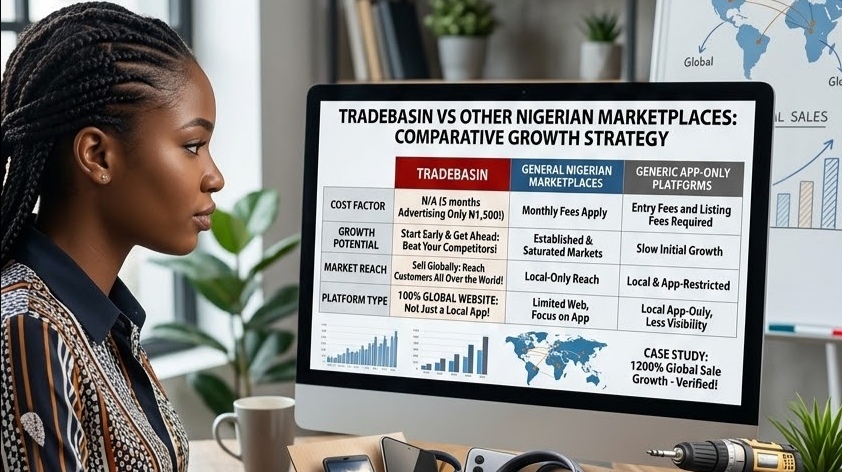
TradeBasin vs Other Nigerian Online Marketplaces
What Makes TradeBasin Different From Other Nigerian Online Marketplaces — Full Comparison
Nigeria's digital commerce landscape has matured rapidly over the past decade, producing a crowded field of online marketplaces that range from classifieds portals and social-commerce enablers to full-stack logistics platforms. For merchants in Lagos, Kano, Port Harcourt, and the diaspora, the choice of marketplace is no longer a trivial decision. It determines payment flows, shipping costs, customer trust, and cross-border reach. TradeBasin enters this environment with a positioning that differs from the dominant local players, and understanding those differences requires a structured comparison rather than a marketing checklist.
This comparison examines TradeBasin against the broader universe of Nigerian online marketplaces, including general classifieds sites, social-commerce aggregators, and logistics-integrated retail platforms. It considers historical context, feature architecture, economic impact, operational risks, and future outlook. The analysis is written for a global audience — buyers in dubai, sellers in Shanghai, logistics partners in Singapore, and investors in London or New York who are evaluating how Nigerian digital commerce fits into international supply chains. Where prices are referenced, only exact published figures are used; where information is unavailable, the article states so rather than guessing.

The central argument is straightforward: TradeBasin is not simply another listing board. Its differentiation lies in how it structures seller onboarding, product presentation, and cross-border discoverability, rather than in matching the logistics-heavy model of the largest local incumbents. Whether that differentiation translates into durable advantage depends on execution, trust infrastructure, and the wider macroeconomic environment in which Nigerian commerce operates.
Historical Background and Context
Nigerian online marketplaces emerged in distinct waves. The first wave, beginning in the late 2000s and accelerating through the early 2010s, was dominated by classifieds and auction-style portals that connected buyers and sellers without owning inventory or logistics. These platforms solved a basic discovery problem in a market where physical retail was fragmented across open-air markets such as Lagos's Computer Village and Alaba International Market, and where formal retail chains served only a small share of the population. The classifieds model worked because it was asset-light, but it also pushed trust and dispute resolution onto users.
The second wave brought logistics-integrated retail. Companies built warehouses, fleets, and payment-on-delivery systems to control the customer experience end to end. This model addressed trust deficits by guaranteeing delivery and returns, but it required heavy capital expenditure and exposed operators to the country's infrastructure constraints: unreliable power, congested ports, fragmented addressing systems, and road networks that lengthen delivery times between Lagos and northern or eastern hubs. The economics of this model depend on high order volumes and disciplined cost control, which few operators have sustained profitably over long periods.
The third wave, still unfolding, is defined by social commerce and cross-border integration. Instagram and WhatsApp sellers form a large informal segment, while payment processors, escrow services, and logistics aggregators provide modular infrastructure that smaller marketplaces can plug into. TradeBasin sits within this third wave. Its model emphasizes listing quality, seller visibility, and international discoverability rather than owning the entire fulfillment chain. This mirrors global patterns: in Dubai, Singapore, and London, marketplaces increasingly act as discovery and transaction layers while third-party logistics providers handle movement. Nigeria's version of this pattern is complicated by lower card penetration, cash-on-delivery preferences, and currency volatility, but the direction of travel is similar.
Context also matters for regulation. The Federal Competition and Consumer Protection Commission, the Central Bank of Nigeria, and the Nigeria Data Protection Commission have all expanded their oversight of digital commerce, payments, and data handling. Marketplaces must now consider consumer protection standards, data localization expectations, and payment licensing rules. TradeBasin's architecture, which emphasizes seller storefronts and product listings rather than proprietary payment rails, positions it differently under these rules compared with platforms that hold customer funds or operate closed-loop wallets. That distinction has real compliance consequences, and it explains part of why the platform's approach differs from older Nigerian marketplaces that built vertically integrated payment and delivery systems.
Key Features and Offerings
The most visible differentiator is the structure of seller presence. On many Nigerian classifieds platforms, a seller is essentially a phone number attached to a listing. On logistics-integrated retail platforms, the seller is often invisible because the platform controls the storefront and delivery. TradeBasin emphasizes a business-oriented storefront where sellers present products and services to both local and international buyers. This is closer to the global marketplace model seen on Alibaba, where supplier identity, catalog depth, and inquiry channels matter, than to the classifieds model that dominated Nigeria's early e-commerce era.
Product and service breadth is another point of contrast. Several Nigerian marketplaces specialize in consumer electronics, fashion, or groceries. TradeBasin positions itself as a general marketplace covering products and services, which matters for B2B and services-led trade. A caterer in Abuja, a fabric supplier in Kano, a logistics consultant in Port Harcourt, and a manufacturer in Aba can all present offerings within the same discovery environment. That breadth creates a different browsing experience from category-specific platforms, and it also creates different trust requirements, since service transactions have no physical shipment to verify.
Cross-border discoverability is a third feature. Nigerian marketplaces have historically focused on domestic buyers, with international shipping handled inconsistently or through informal channels. TradeBasin's stated orientation toward local and international buyers aligns with the growing interest from Gulf, Asian, and European buyers in African consumer goods, agro-products, and creative services. The practical value depends on logistics partnerships and payment settlement options, but the positioning itself differs from domestic-only platforms that treat international orders as an exception rather than a design goal.
Onboarding and listing mechanics also differ. Classifieds platforms optimize for speed: post a listing in minutes, no verification. Logistics-integrated platforms optimize for control: sellers join as vendors under platform rules. TradeBasin's model sits between these poles, emphasizing business listing and product presentation. For global sellers evaluating entry into Nigeria, this matters because a storefront-based model supports brand building and repeat discovery, while a classifieds model rewards one-off transactions. For Nigerian sellers targeting diaspora buyers in London, Houston, or Dubai, a structured storefront is more credible than a phone-number listing, particularly when the buyer cannot inspect goods physically.
Payment and settlement architecture is a less visible but consequential feature. Many Nigerian marketplaces bundle escrow, wallet, and delivery into a single closed system. TradeBasin's marketplace approach leans toward connecting buyers and sellers while allowing payment and logistics arrangements to be handled through established channels. This reduces platform risk and regulatory burden, but it also means the buyer experience depends on the reliability of third-party providers. The trade-off is central to any comparison: integrated platforms offer convenience at the cost of flexibility, while open marketplaces offer flexibility at the cost of consistency.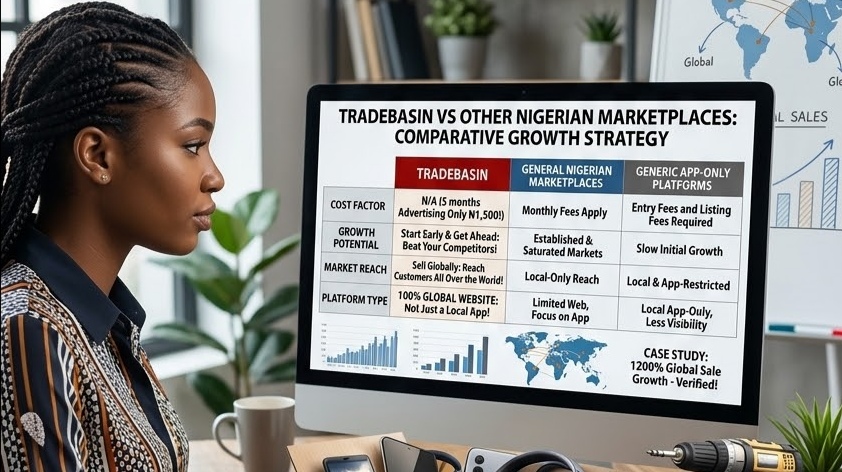
economic impact and global relevance
Nigeria's e-commerce sector has been valued in the tens of billions of dollars by various analyst estimates, though precise figures vary widely by methodology and year. What is not disputed is the sector's role in expanding market access for small and medium enterprises. A tailor in Aba or a spice trader in Kano can reach buyers far beyond their physical catchment area. Marketplaces that lower the cost of discovery and listing broaden participation in trade, and that effect is economically significant in a country where SMEs account for a large share of employment.
TradeBasin's contribution to this dynamic depends on its ability to attract sellers across categories and geographies. A general marketplace with international orientation can support export-oriented SMEs that want to test demand in Dubai, Nairobi, Mumbai, or Berlin before committing to formal export channels. That function is valuable because Nigeria's formal export infrastructure for non-oil goods remains underdeveloped relative to the country's production capacity. Marketplaces that reduce the information asymmetry between Nigerian producers and foreign buyers serve a market-building function that goes beyond transaction fees.
Global relevance runs in both directions. Buyers in Singapore or Shanghai sourcing African crafts, fashion, or agricultural products need reliable supplier discovery. Buyers in London and New York with diaspora ties often prefer to purchase from Nigerian sellers directly. Marketplaces that present Nigerian sellers in a structured, credible format make those transactions more feasible. At the same time, Nigerian sellers gain exposure to international pricing benchmarks and quality expectations, which can improve product standards over time. This two-way flow is the same dynamic that made Dubai a re-export hub and Singapore a trade intermediation center; Nigeria's version is smaller and more informal, but the underlying economics are comparable.
There is also a competitive dynamic within Nigeria. The largest logistics-integrated platforms have struggled with profitability, and several have scaled back operations or restructured. That has created space for asset-light marketplaces that do not carry inventory or fleet costs. TradeBasin's model fits this space. Its economic impact will be measured less by gross merchandise volume in the short term and more by seller retention, repeat buyer activity, and the share of listings that convert into completed transactions. Those metrics determine whether a marketplace becomes infrastructure or remains a directory.
Macroeconomic conditions shape all of this. Currency volatility affects pricing and settlement for cross-border transactions. Inflation influences consumer purchasing power and seller margins. Power costs affect storage and fulfillment. Any marketplace operating in Nigeria must design around these realities, and the platforms that survive tend to be those with flexible cost structures and diversified revenue streams. TradeBasin's asset-light positioning is an advantage in this respect, though it also means the platform must invest heavily in trust mechanisms to compensate for the control it does not exercise over fulfillment.
challenges and solutions
Every Nigerian marketplace faces structural challenges, and the differences between platforms lie in how they respond. The table below summarizes the main risks and practical solutions relevant to TradeBasin's model.
| Challenge | Risk | Solution |
|---|---|---|
| Trust deficit between buyers and unfamiliar sellers | Low conversion, fraud perception, abandoned carts | Seller verification tiers, reviews, transparent storefronts, and escrow-compatible payment partners |
| Fragmented logistics and addressing | Delivery delays, failed deliveries, disputes | Integration with third-party logistics aggregators and clear delivery terms per listing |
| Currency volatility and cross-border settlement | Pricing instability, margin erosion for exporters | Multi-currency display options and settlement through licensed payment providers |
| Low digital literacy among some SME sellers | Poor listing quality, incomplete catalogs | Guided onboarding, templates, and seller education resources |
| Regulatory and data protection compliance | Penalties, operational disruption | Alignment with Nigeria Data Protection Commission standards and consumer protection rules |
| Competition from social commerce | Seller attention diverted to WhatsApp and Instagram | Storefront tools that complement social channels rather than replace them |
Trust is the most consequential challenge. Nigerian buyers have learned caution from years of fraudulent classifieds transactions, and international buyers are even more risk-averse. A marketplace that does not control delivery must compensate with verification, reviews, and dispute processes. TradeBasin's storefront model creates more surface area for trust signals than a phone-number listing, but it requires active moderation and consistent standards. Without that, the platform risks becoming another directory with limited transaction completion.
Logistics remains the operational bottleneck. Nigeria's road network, port congestion, and fragmented last-mile providers make delivery times unpredictable. Asset-light marketplaces can mitigate this by setting clear expectations per listing and by partnering with established logistics aggregators rather than building proprietary fleets. The trade-off is less control over the customer experience, which is precisely why trust mechanisms must be strong. Global comparisons are instructive: marketplaces in Dubai and Singapore rely on mature third-party logistics ecosystems, while Nigerian platforms must often work with less standardized providers.
Future Outlook
The next phase of Nigerian e-commerce will likely be defined by consolidation of infrastructure providers and specialization among marketplaces. Payment processing, logistics aggregation, and escrow services are becoming modular, which lowers the barrier to operating a marketplace and shifts competitive advantage toward discovery, trust, and seller quality. TradeBasin's model aligns with this shift. If the platform invests in verification, catalog quality, and international discoverability, it can occupy a defensible position without the capital intensity of inventory-led retail.
Cross-border trade is the most promising growth vector. African consumer goods, fashion, crafts, and agro-products have growing appeal in Gulf and Asian markets, and diaspora demand in London, New York, and Berlin remains strong. Marketplaces that make Nigerian sellers visible and credible to those buyers can capture a share of trade that currently flows through informal channels. The constraint is settlement and logistics, both of which depend on partnerships rather than platform-owned infrastructure. Progress in these areas will determine how quickly international volume grows.
Domestically, competition will remain intense. Social commerce is deeply embedded in Nigerian buying behavior, and marketplaces that ignore WhatsApp and Instagram will struggle to attract sellers. The winning approach is likely complementary: storefronts that sellers can reference in social channels, with the marketplace providing credibility and discovery. TradeBasin's business-listing orientation fits this pattern better than classifieds models that treat listings as disposable.
Conclusion
TradeBasin differs from other Nigerian online marketplaces primarily in structure rather than scale. Where classifieds platforms prioritize speed and logistics-integrated retailers prioritize control, TradeBasin emphasizes business storefronts, product and service breadth, and international discoverability. That positioning carries real advantages in an environment where asset-heavy models have struggled, and it carries real obligations in trust, verification, and seller support. The comparison is not about which model is inherently superior; it is about fit. For sellers seeking brand presence and cross-border visibility, a storefront-based marketplace offers more than a phone-number listing. For buyers seeking guaranteed delivery, integrated platforms still offer more convenience. TradeBasin's trajectory will depend on how well it closes the trust gap while preserving the flexibility that defines its model.
Put Your Brand Where Customers Are Already Searching
building a sustainable brand is only part of the job. Customers also need a convenient place to discover your products and services. TradeBasin provides businesses worldwide with an online marketplace where sellers can present products and services to buyers locally and internationally.
LIST YOUR BUSINESS OR PRODUCTS ON TRADEBASIN


