 Global Trade & Commodities
Yaowarat Bangkok: Street Food and Gold Trading Hub
The Dual Economy of Yaowarat Chinatown Bangkok
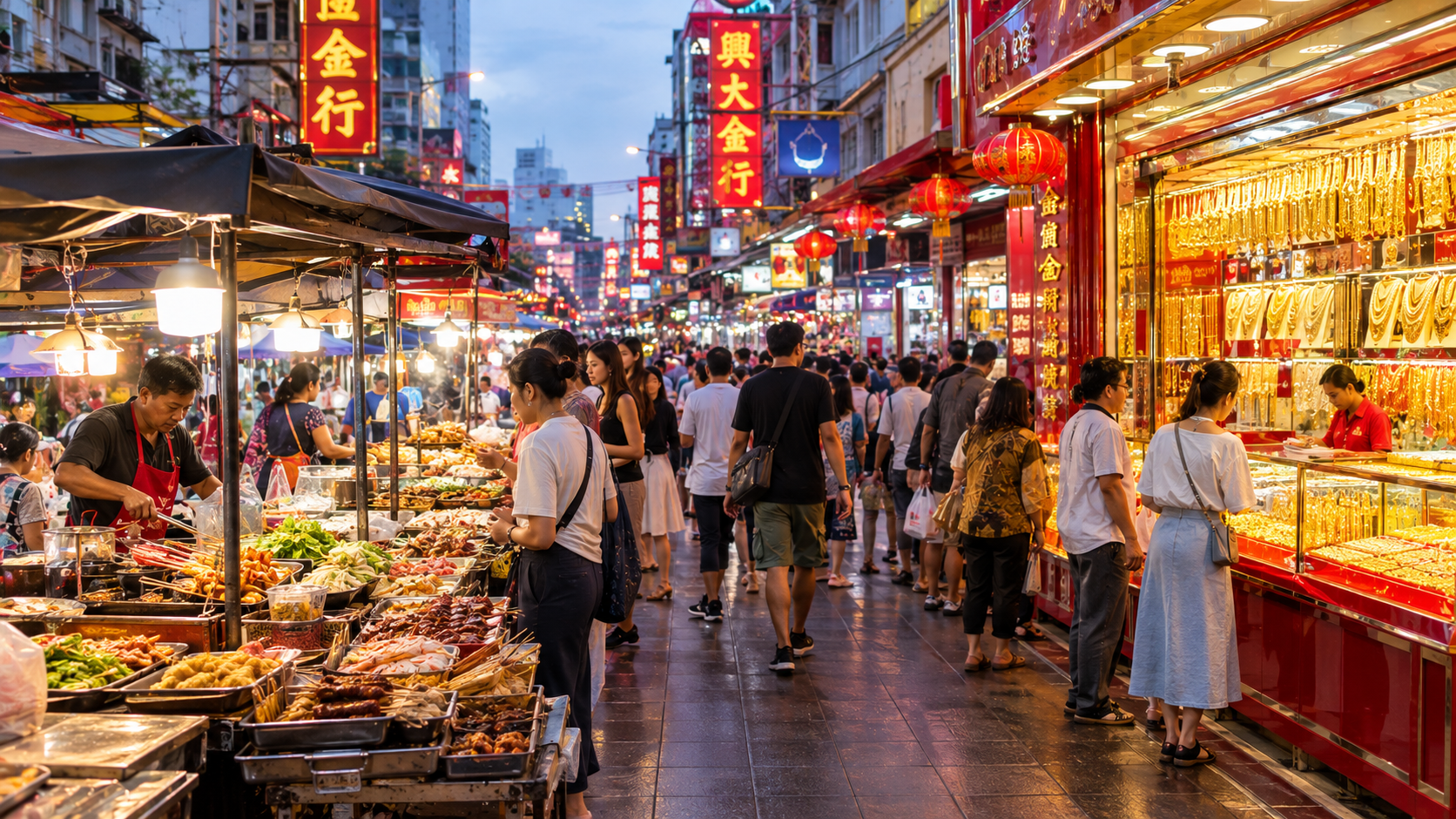
Yaowarat Road, the spine of Bangkok's Chinatown, represents one of the most unusual commercial corridors in the world. Within a stretch of roughly one and a half kilometres, the district operates two distinct but interwoven economies: a street food ecosystem that has earned global recognition from culinary institutions and international media, and a gold trading market that functions as a genuine price-setting and physical distribution node for Southeast Asia. For a global business audience, Yaowarat matters less as a tourist curiosity and more as a case study in how dense, culturally rooted commercial clusters can generate outsized economic influence without the infrastructure of a formal financial district.
The district sits in the Samphanthawong area of Bangkok, adjacent to the Chao Phraya River and the historic Rattanakosin core. Its street food stalls, many operating for decades under the same family ownership, draw millions of visitors annually. Simultaneously, its gold shops process transactions ranging from small retail purchases to wholesale bullion movements that connect Thai domestic demand with refining centres in Switzerland, Hong Kong, Singapore, and the United Arab Emirates. This dual identity creates a commercial environment where a food vendor and a bullion dealer can operate within metres of each other, serving entirely different customer bases yet contributing to the same district-level economic output.

Understanding Yaowarat requires moving past the postcard image of neon signs and woks. The district is a functioning trade ecosystem with supply chains, credit relationships, price discovery mechanisms, and regulatory interfaces. It offers lessons for businesses in Dubai's Deira souks, Lagos's Balogun Market, Mumbai's Zaveri Bazaar, and London's Hatton Garden — all districts where cultural clustering and specialised trade reinforce one another. Yaowarat's specific combination of perishable-goods retail and high-value commodities makes it a rare hybrid that global retailers, commodity traders, and urban economists continue to study.
Historical Background and Commercial Context
Yaowarat's commercial identity traces to the late eighteenth and early nineteenth centuries, when Chinese merchants and labourers, predominantly from the Teochew region of Guangdong, settled along the Chao Phraya River. The area developed as a trading settlement during the early Rattanakosin period, and successive waves of immigration reinforced its role as a hub for rice milling, shipping, and wholesale distribution. The street itself was named after King Chulalongkorn's visit to the region, and the name Yaowarat became synonymous with Chinese commercial activity in Bangkok.
Gold trading emerged organically from this merchant base. Chinese communities across Southeast Asia historically held gold as a store of value, and the Teochew traders who dominated Yaowarat's commerce formalised this practice into a network of family-run gold shops. These shops initially served local savings demand, converting cash into jewellery and gold bars that could be pledged, sold, or inherited. Over generations, the shops accumulated the capital and sourcing relationships needed to operate at wholesale scale, and Yaowarat became a reference point for gold pricing in Thailand.
The street food economy developed in parallel, driven by the same demographic density. Chinese labourers and traders required affordable, fast meals, and food stalls proliferated in the alleys and sidewalks around Yaowarat Road. Dishes such as kuay jab (rolled noodle soup), ba mee (egg noodles), and seafood preparations became signatures of the district. The food culture persisted through economic cycles because it served both residents and, increasingly from the 1980s onward, tourists seeking authentic culinary experiences.
Thailand's gold market formalisation occurred through the 20th century, with the Thai Gold Traders Association becoming a key institutional actor. The association standardised weights, purity conventions, and reporting practices, and the Bangkok gold price became a recognised benchmark domestically. Yaowarat's concentration of gold shops made it the physical centre of this market. Meanwhile, the street food scene received international validation through media coverage and, later, recognition from global culinary bodies, cementing its reputation as a destination in its own right.
Key Features and Offerings
The gold trading dimension of Yaowarat operates on a scale that surprises many international observers. Thai gold jewellery is typically sold at 96.5 percent purity, a standard distinct from the 99.9 percent bullion common in London or Zurich markets. This purity convention, combined with a traditional weight unit called the baht (15.244 grams), creates a localised pricing system that the Thai Gold Traders Association translates into daily reference prices. Yaowarat's gold shops display these prices prominently, and the district effectively functions as a physical exchange where retail buyers, pawnbrokers, and wholesale dealers converge.
Transaction volumes in Yaowarat's gold market are substantial. The district's shops handle everything from single-baht jewellery purchases to multi-kilogram wholesale orders. During periods of economic uncertainty, Thai households historically increase gold purchases as a hedge, and Yaowarat absorbs a significant share of this demand. The shops also operate buy-back arrangements, creating a liquid secondary market that supports the primary trade. This two-way flow distinguishes Yaowarat from pure retail jewellery districts and gives it characteristics closer to a commodity market.
The street food ecosystem operates with equally distinctive features. Yaowarat's food vendors specialise in Teochew-influenced Chinese Thai cuisine, and many stalls have operated for two or three generations. The district's food economy is characterised by high turnover, narrow margins, and intense competition. Vendors source from nearby wholesale markets, including Khlong Thom and Pak Khlong Talat, creating short supply chains that keep costs low. The density of stalls means customers can compare offerings within seconds, and reputation functions as the primary marketing mechanism.
Several Yaowarat establishments have achieved international recognition. Street food vendors in the district have received attention from global culinary guides, and the area's seafood stalls, noodle shops, and dessert vendors attract both domestic and international visitors. The food economy also supports a broader ecosystem of suppliers, delivery services, and packaging businesses. For global food and beverage brands studying market entry, Yaowarat demonstrates how heritage, density, and consistency can build durable consumer loyalty without formal branding investment.
The two economies share infrastructure and customer flows. Visitors often combine gold purchases with meals, and the district's evening economy, when food stalls and gold shops operate simultaneously, generates peak commercial activity. This synergy is not accidental; it reflects decades of organic commercial development in a confined urban space.
Economic impact and global relevance
Yaowarat's economic contribution extends well beyond district boundaries. Thailand is one of the world's significant gold consumption markets, and Yaowarat functions as the physical heart of that market. The Thai Gold Traders Association's daily price, influenced by London and other international benchmarks, is transmitted through Yaowarat's shops to provincial dealers across the country. This makes the district a distribution hub linking global bullion markets to domestic retail demand. When international gold prices move, Yaowarat's shops adjust within hours, and the district's pricing signals ripple through Thailand's gold trading network.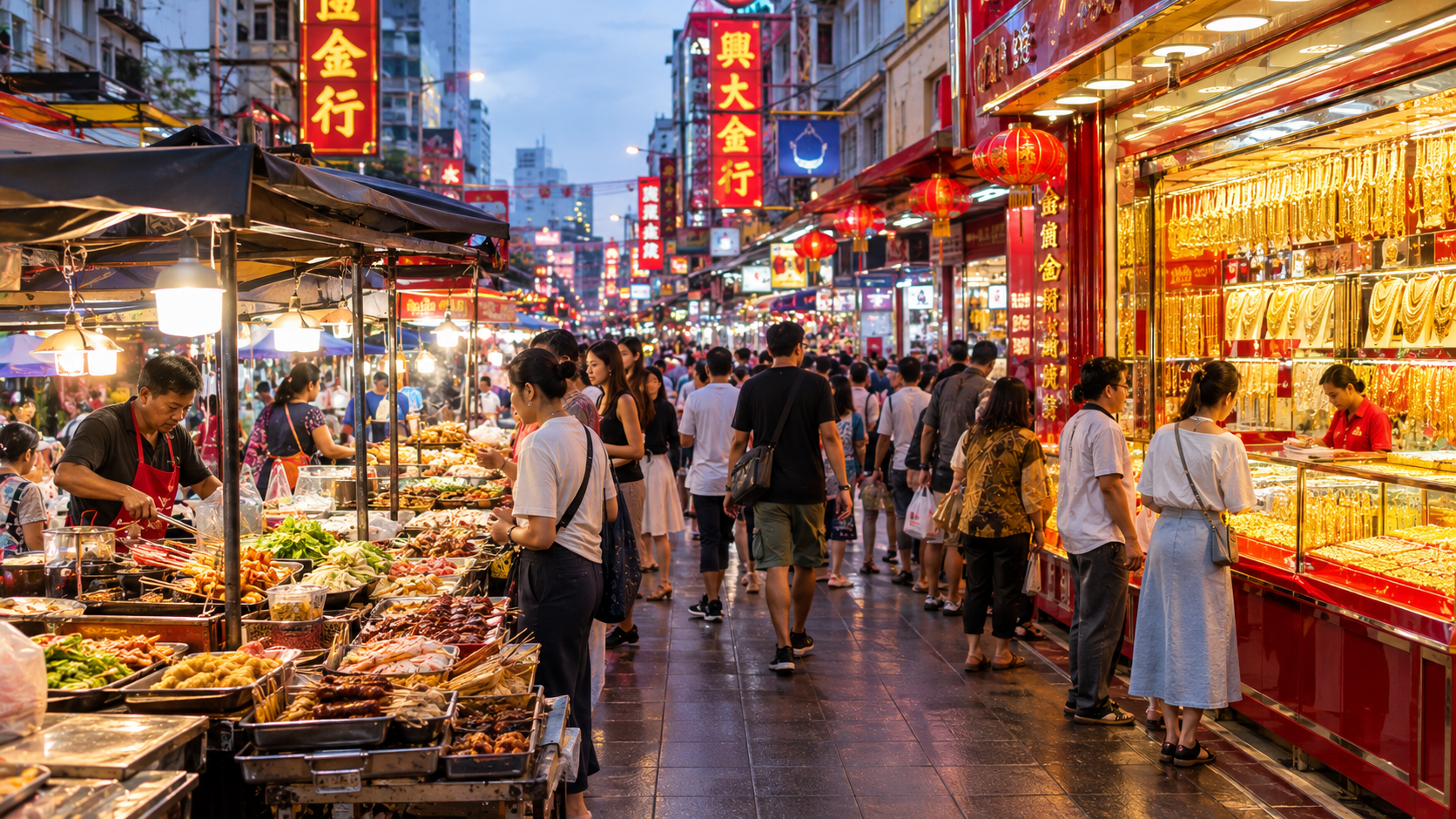
The global relevance is reinforced by Thailand's position as a gold trading and refining participant in Southeast Asia. Bangkok's gold market connects with Hong Kong, Singapore, and Dubai, and Yaowarat's dealers maintain sourcing and hedging relationships with international counterparties. For commodity traders in London or Zurich, Yaowarat represents an important demand aggregation point. For jewellers in Mumbai or Dubai, it offers a model of how cultural trust and physical clustering can sustain high-value trade.
The street food economy contributes a different but substantial economic layer. Bangkok's food sector is a major employer, and Yaowarat's stalls support thousands of direct and indirect livelihoods. Food tourism generates spending that extends to hotels, transport, and retail across the city. International media coverage of Yaowarat's food scene functions as free marketing for Bangkok's tourism economy, and the district's reputation supports Thailand's broader culinary exports, including packaged foods and restaurant franchises.
The district also illustrates the economic value of agglomeration. Gold shops cluster because proximity reduces search costs for buyers and facilitates information sharing among dealers. Food stalls cluster because density attracts foot traffic. This agglomeration logic is visible in global hubs: Dubai's gold souk in Deira, Singapore's Little India for food and textiles, London's Hatton Garden for jewellery, and Shanghai's Yu Garden for heritage commerce. Yaowarat's specific combination of perishable and durable goods trade makes it a distinctive case that urban economists and trade analysts reference when discussing mixed-use commercial districts.
For businesses considering market entry in Thailand or Southeast Asia, Yaowarat offers a practical lesson: cultural authenticity and commercial credibility reinforce each other. Brands that respect local conventions, whether in gold purity standards or food preparation methods, gain access to networks that are difficult to replicate through conventional retail expansion.
challenges and solutions
Yaowarat faces structural pressures that affect both of its core economies. Urban redevelopment, regulatory changes, and shifting consumer behaviour create risks that require coordinated responses from businesses, associations, and public authorities.
| Challenge | Risk | Solution |
|---|---|---|
| Rising rents and property redevelopment | Displacement of long-established food vendors and small gold shops | Heritage zoning protections, lease stability agreements, and vendor association negotiations with landlords |
| Gold price volatility and currency fluctuations | Margin compression for dealers and reduced retail demand during sharp price swings | Hedging through international counterparties, transparent daily pricing, and diversified product offerings |
| Food safety and hygiene regulation | Compliance costs for small vendors and reputational risk for the district | Shared compliance facilities, association-led training, and phased enforcement timelines |
| Overtourism and congestion | Erosion of local character and reduced access for residents | Visitor flow management, pedestrianisation pilots, and promotion of off-peak and secondary alleys |
| Competition from e-commerce and organised retail | Decline in footfall for traditional shops | Hybrid models combining physical presence with online ordering and delivery partnerships |
| Informal credit and record-keeping practices | Limited access to formal finance and scalability constraints | Digital payment adoption, bookkeeping support, and microfinance partnerships |
Each challenge carries implications for global businesses watching the district. Rent pressure in Yaowarat mirrors patterns in Dubai's Deira, where gold souk traders face redevelopment, and in London's markets, where heritage vendors negotiate with property developers. The gold volatility issue is universal, and Yaowarat's dealers manage it through relationships with international refiners and banks. Food safety regulation is a shared concern across Southeast Asian street food economies, and association-led training models in Bangkok offer a template for cities in Lagos, Nairobi, and Mumbai.
The solutions require coordination rather than individual action. Trade associations, municipal authorities, and business networks must align on zoning, compliance, and digital infrastructure. Yaowarat's gold traders already operate through an association structure that standardises pricing and practices; extending that coordination to food vendors and property negotiations would strengthen the district's resilience.
Future Outlook
Yaowarat's future depends on how successfully it balances preservation with modernisation. The gold trading economy is likely to consolidate, with larger dealers adopting digital pricing, online ordering, and international hedging while smaller shops specialise in retail and buy-back services. Thailand's gold market will remain globally connected, and Yaowarat's role as a physical hub is unlikely to disappear, but its operating model will increasingly incorporate technology. Payment digitisation, already spreading across Bangkok, will reduce cash handling and improve transaction records, which in turn supports access to formal credit.
The street food economy faces a different trajectory. Demand for authentic culinary experiences remains strong, and Yaowarat's reputation provides durable competitive advantage. However, rising costs and regulatory pressure may push vendors toward hybrid models that combine physical stalls with delivery and packaged products. Some vendors may formalise into small restaurants, while others may exit. The district's ability to retain its character will depend on lease protections and support for succession, since many stalls face ownership transitions as founding families age.
Globally, Yaowarat's experience offers lessons for cities managing heritage commercial districts. The district demonstrates that cultural clustering and specialised trade can coexist with tourism and modern retail if governance is coordinated. For international businesses, Yaowarat remains a gateway to Thai consumer markets and a reference point for gold pricing and food trends. Its evolution will be watched by commodity traders in London and Dubai, food brands in Singapore and Shanghai, and urban planners in Lagos and Nairobi.
Conclusion
Yaowarat Chinatown Bangkok is more than a tourist destination. It is a functioning commercial ecosystem where street food and gold trading operate as complementary economies, each with its own supply chains, pricing mechanisms, and customer bases. The district's historical roots in Teochew merchant settlement created the trust and clustering that still underpin its commercial success. Its gold market connects Thai domestic demand to global bullion flows, while its food economy generates employment, tourism revenue, and international cultural influence.
For a global business audience, Yaowarat illustrates how density, heritage, and specialised trade can produce durable economic value. The challenges it faces — rent pressure, regulation, volatility, and competition — are shared by comparable districts in Dubai, London, Mumbai, and Lagos. The solutions require coordinated action among businesses, associations, and authorities. Yaowarat's future will be shaped by how well it preserves its commercial character while adopting the digital and regulatory tools needed to remain competitive. Businesses and policymakers watching the district will find lessons that apply well beyond Bangkok.
Put Your Brand Where Customers Are Already Searching
building a sustainable brand is only part of the job. Customers also need a convenient place to discover your products and services. TradeBasin provides businesses worldwide with an online marketplace where sellers can present products and services to buyers locally and internationally.
LIST YOUR BUSINESS OR PRODUCTS ON TRADEBASIN


