 General
South Street Seaport and Fulton Market: New York's Historic Fish Trade
South Street Seaport and Fulton Market: The Engine Room of New York's Fresh Food Economy
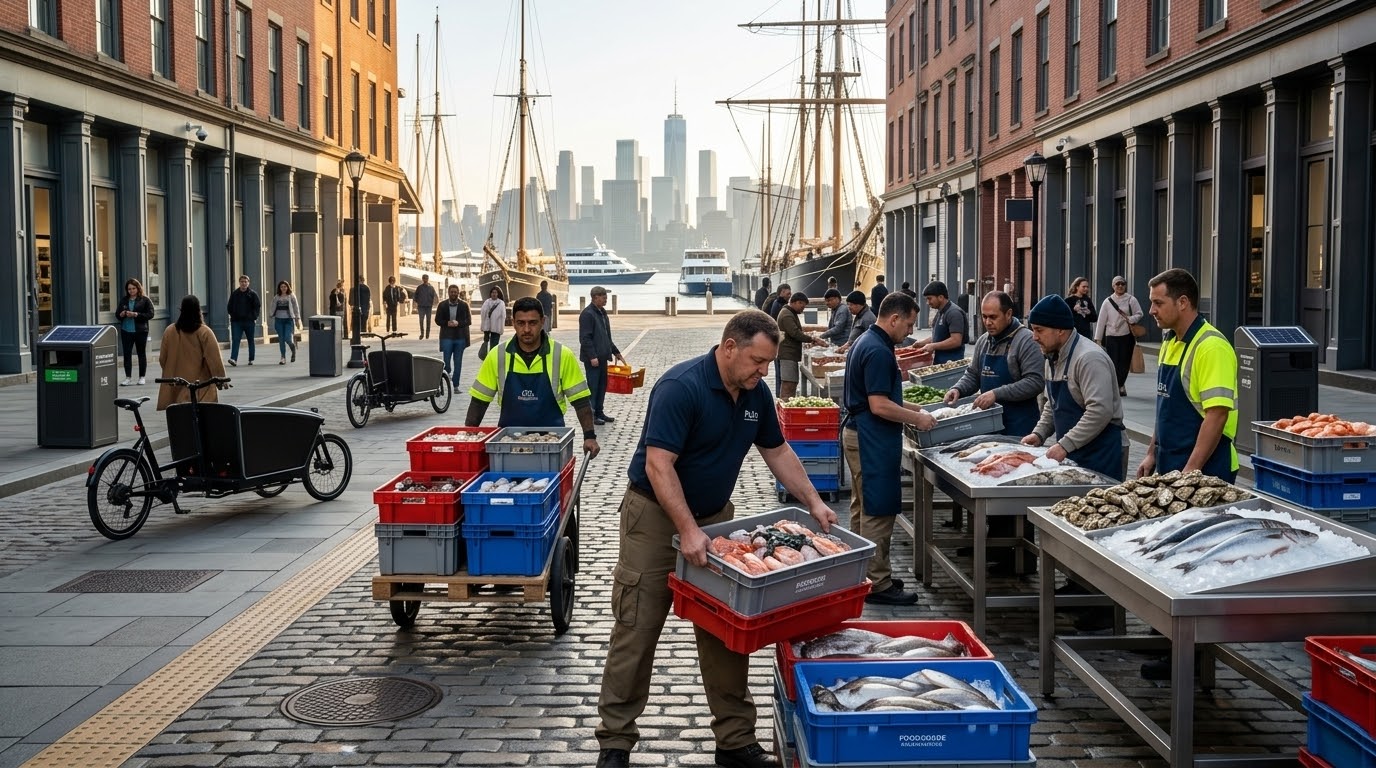
For more than a century, the cobblestone blocks where Manhattan's South Street meets the East River functioned as one of the most consequential food trading districts on earth. South Street Seaport and the adjacent Fulton Market formed a dense commercial ecosystem in which fishing fleets, oyster dredgers, wholesale auctioneers, provision merchants, ship chandlers, and immigrant laborers interacted daily under the pressure of tides, weather, and the relentless urban demand for fresh protein. At its peak in the middle decades of the nineteenth century, this waterfront precinct handled a volume and variety of fish and perishable food that rivaled any port in Europe or Asia, and it did so without refrigeration, electricity, or motorized transport. The result was a trading culture built on speed, trust, credit, and intimate knowledge of perishability.
The story of South Street and Fulton Market is relevant well beyond the boundaries of New York City. It illustrates how physical marketplaces aggregate supply and demand, how auction mechanisms discover prices for goods that decay quickly, and how infrastructure such as wharves, ferries, ice houses, and rail connections determines which cities become food trading capitals. Those same dynamics are visible today in Dubai's re-export hubs, Singapore's cold-chain logistics parks, London's Billingsgate and Borough markets, Shanghai's wholesale fish auctions, Lagos and Nairobi's informal fresh-food networks, and Mumbai's coastal fish supply chains. Understanding the historic mechanics of Fulton Market offers a useful lens for anyone analyzing modern fresh food commerce, whether in New York, Berlin, or beyond.

This article examines the historical background of the district, its key features and offerings, its economic impact and global relevance, the challenges it faced and the solutions adopted, and the outlook for its legacy in a world of digital marketplaces.
Historical Background and Context
New York's relationship with the East River fishery predates the United States itself. Dutch colonists in the seventeenth century established fishing and trading activity along the shoreline that would eventually become South Street, recognizing that the confluence of the East River, the Hudson, and the Atlantic migratory routes produced an extraordinary abundance of oysters, shad, sturgeon, bass, and cod. The natural harbor offered deep water close to shore, shelter from ocean storms, and direct access to inland markets via rivers and later canals. These geographic advantages created the conditions for a specialized food trading district long before formal market buildings existed.
The Fulton Market itself opened in 1822 on the East River waterfront, named for Robert Fulton, the steamboat pioneer whose vessels had transformed movement on the Hudson and East River. The market's founding coincided with the rapid commercial expansion of New York following the opening of the Erie Canal in 1825, which connected the port to the agricultural interior of the state and the Great Lakes region. That canal linkage flooded the city with grain, livestock, and produce, while simultaneously creating a population dense enough to sustain a massive fresh fish trade. South Street became the spine of this activity, lined with wholesale fish dealers, oyster houses, provision stores, and maritime supply businesses.
Throughout the nineteenth century, Fulton Market evolved into the city's principal wholesale fish market, operating through a consignment and auction system. Fishing vessels arriving from Long Island Sound, the New Jersey coast, and the deeper Atlantic grounds would unload at the adjacent piers, and the catch would be sold through commission merchants who acted as intermediaries between boat captains and retail fishmongers, hotels, restaurants, and household buyers. The auction format allowed prices to adjust daily to supply, weather, and seasonal abundance, an early and highly efficient mechanism for price discovery in a perishable goods market. Similar commission and auction systems developed in London's Billingsgate, Paris's Les Halles, and later in Tokyo's Tsukiji, demonstrating a common institutional response to the problem of trading goods that spoil quickly.
The district's importance persisted into the early twentieth century. New York's fish trade continued to operate from the Fulton Market area until the market's functions were relocated to the Fulton Fish Market site under the Brooklyn Bridge in 1939, and eventually to Hunts Point in the Bronx in 2005. The South Street Seaport Historic District, designated in the 1960s and revitalized in the late twentieth century, preserved the architectural fabric of the old trading quarter, including Schermerhorn Row, the counting houses, and the piers that once received fishing vessels. That preservation transformed a working food market into a heritage and tourism destination, a transition that raises important questions about how cities balance commercial function with cultural memory.
The broader context is one of urban food system evolution. As cities grow, fresh food trading typically migrates from dense waterfront locations toward peripheral wholesale terminals because of congestion, real estate values, and the need for truck and rail access. New York followed this pattern, as did London when Billingsgate and Smithfield markets relocated, and as did many Asian and African cities in the twentieth and twenty-first centuries. Fulton Market's history therefore serves as a template for understanding how and why fresh food trading districts move, and what is gained and lost in the process.
Key Features and Offerings
The South Street Seaport and Fulton Market district offered a remarkably comprehensive range of goods and services. Fish and shellfish dominated the trade, with oysters forming the backbone of early volume. New York Harbor's oyster beds were among the richest in the world, and the city's oyster houses became famous for cheap, abundant shellfish consumed by rich and poor alike. Shad and shad roe were seasonal delicacies whose arrival marked the spring trading calendar. Cod, mackerel, bluefish, striped bass, eels, clams, and lobsters rounded out a portfolio that changed with the seasons and the migrations of species along the Atlantic coast.
Beyond fish, Fulton Market functioned as a general fresh food trading hub. Produce, poultry, game, butter, eggs, and cheese moved through adjacent market buildings and stalls. Provision merchants supplied ships with salted meat, hardtack, and preserved goods, linking the food trade directly to the maritime economy. Ship chandlers, sailmakers, and coopers supported the fishing fleet, creating an integrated cluster in which food trading and maritime services reinforced one another. This clustering effect is a recurring feature of successful trading districts globally, from the spice souks of Dubai's Deira to the textile and food wholesale clusters of Shanghai and Mumbai.
The trading mechanisms themselves were a key offering. Commission merchants provided credit and market access to fishing captains who lacked the time or connections to sell directly to retailers. Auctioneers ran daily sales that established reference prices. Ice houses and later mechanical refrigeration extended the shelf life of catch, allowing trade to expand beyond the immediate metropolitan area. Rail connections, particularly after the mid-nineteenth century, allowed fresh fish to reach inland cities, turning New York into a distribution node rather than merely a local market. Each of these features mirrors functions performed today by cold-chain logistics providers, commodity exchanges, and wholesale market authorities in cities such as Singapore, Berlin, and Nairobi.
The district also functioned as a labor market and immigrant gateway. Irish, German, Italian, and later Eastern European and Chinese workers found employment in fishing, unloading, packing, selling, and provisioning. Fulton Market's commercial culture was multilingual and intensely competitive, with bargaining conducted in several languages and credit relationships built on reputation and ethnic networks. This social infrastructure was as important as the physical infrastructure in making the market work, a point frequently emphasized in studies of informal and semi-formal food trading in Lagos, Mumbai, and other rapidly urbanizing centers.
Finally, the Seaport district offered ancillary amenities that supported trade: taverns, boarding houses, banks, and shipping offices. These services reduced transaction costs and increased the velocity of commerce. Modern marketplaces replicate this logic through digital platforms that bundle payments, logistics, insurance, and dispute resolution alongside the core buying and selling function, demonstrating continuity between nineteenth-century waterfront commerce and twenty-first-century online trade.
Economic Impact and Global Relevance
The economic impact of South Street Seaport and Fulton Market extended far beyond the value of the fish sold. The district generated employment across fishing, transport, processing, retail, and hospitality. It supported a fleet of vessels and the shipbuilding and repair trades that serviced them. It attracted capital into cold storage, ice harvesting, and wholesale facilities. It fed a growing city whose population expanded from roughly 120,000 in 1820 to over a million by 1860, and it helped establish New York as the dominant port of the United States. Food security for a rapidly industrializing metropolis depended on the reliability of this trading system.
The market also contributed to the development of financial and commercial institutions. Wholesale credit, marine insurance, and commodity price reporting all developed in close association with the port trades. The daily auction prices for fish and oysters functioned as reference points for buyers and sellers across the region, an early form of market transparency. Similar price-discovery functions are now performed by electronic exchanges and wholesale market authorities in London, Shanghai, Singapore, and Dubai, where benchmark prices for seafood and agricultural commodities guide global trade flows.
Globally, the Fulton Market model influenced how other cities organized fresh food distribution. The combination of a centralized wholesale market, an auction or consignment system, and supporting cold-chain infrastructure became a standard template. London's Billingsgate, Paris's Rungis, Tokyo's Toyosu, and Seoul's Garak markets all embody variations on this design. In emerging economies, the same logic appears in less formal settings: Nairobi's Wakulima Market, Lagos's Mile 12 produce market, and Mumbai's Sassoon Dock fish auction all aggregate supply and demand under conditions of perishability and thin margins. The historical experience of Fulton Market offers lessons about congestion, sanitation, and relocation that these cities continue to confront.
The Seaport's later transformation into a heritage and tourism district also has global relevance. Cities worldwide wrestle with how to repurpose obsolete industrial waterfronts. London's Docklands, Singapore's Clarke Quay, Shanghai's Bund, and Hamburg's HafenCity represent different answers to the same question. South Street Seaport demonstrates that preserving the physical memory of food trading can create economic value through tourism, retail, and cultural programming, while also raising concerns about the displacement of working commerce and the communities that depended on it. The tension between heritage and function is a recurring theme in urban food policy from Berlin to Lagos.
For contemporary traders, the district's history underscores a durable principle: proximity and aggregation create market power. Buyers and sellers gravitate to places where they can compare offerings, negotiate quickly, and reduce search costs. Digital marketplaces extend this principle across geographies, allowing a fish processor in Mumbai to reach buyers in dubai or a specialty food producer in Nairobi to reach customers in London. The core economic function is unchanged, even as the medium shifts from cobblestone piers to online storefronts.
challenges and solutions
The history of South Street Seaport and Fulton Market is also a history of persistent operational challenges. Perishability, congestion, sanitation, price volatility, and real estate pressure shaped daily life in the district and ultimately drove its relocation. The table below summarizes the principal challenges, the risks they created, and the practical solutions adopted or proposed over time.
| Challenge | Risk | Solution |
|---|---|---|
| Rapid spoilage of fresh fish and shellfish | Financial loss for merchants and reduced food safety | Ice harvesting and ice houses, later mechanical refrigeration; rapid auction cycles that moved stock within hours |
| Street and pier congestion from carts, vessels, and crowds | Delays, accidents, and higher handling costs | Designated market hours, pier management, and eventual relocation to larger facilities with truck access |
| Sanitation and public health concerns | Disease outbreaks and reputational damage to the market | Municipal inspection regimes, waste removal, and improved drainage and paving |
| Price volatility from weather and catch variability | Income instability for fishermen and merchants | Daily auction price discovery, consignment credit, and diversification into preserved and salted products |
| Real estate pressure and rising land values | Displacement of working commerce | Historic district designation, public market authorities, and relocation to peripheral wholesale terminals |
| Credit risk among buyers and sellers | Defaults and disrupted trading relationships | Reputation-based credit networks, commission merchant intermediation, and formal banking links |
Each of these challenges has a modern analogue. Cold-chain failures remain a major source of loss in fish supply chains across Africa and South Asia. Congestion and sanitation are central issues in Nairobi, Lagos, and Mumbai wholesale markets. Price volatility affects fishing communities worldwide, from New England to Southeast Asia. Real estate pressure threatens working waterfronts in London, New York, and Shanghai alike. The solutions developed in nineteenth-century New York, particularly auction price discovery and cold-chain investment, remain foundational to fresh food commerce today.
The relocation of Fulton Market functions to the Bronx in 2005 illustrates the trade-offs involved. The move provided modern refrigeration, better truck access, and room for expansion, but it separated the market from its historic identity and from the dense customer base of lower Manhattan. Similar debates have accompanied market relocations in London, Seoul, and Tokyo. The lesson is that operational efficiency and cultural continuity are often in tension, and that successful transitions require deliberate planning for both.
Future Outlook
The future of South Street Seaport as a commercial food trading location is limited, but its future as a symbol and case study is substantial. The district now functions primarily as a heritage, retail, and tourism destination, with the working fish trade concentrated at Hunts Point in the Bronx. The Seaport's historic buildings, piers, and cobblestone streets preserve the physical record of a trading economy that shaped New York's growth. Preservation and adaptive reuse have created a template for waterfront revitalization that cities from London to Shanghai continue to study.
At the same time, the underlying functions of Fulton Market are being reinvented digitally. Online marketplaces, cold-chain logistics platforms, and traceability systems now perform the aggregation, price discovery, and credit functions that commission merchants once handled in person. Buyers in Dubai can source seafood from suppliers in Mumbai or Nairobi through digital channels, and sellers can reach customers in London, Berlin, Singapore, or New York without a physical stall. The historic market's emphasis on speed, trust, and reputation finds a direct parallel in modern platform ratings, escrow payments, and verified supplier profiles.
For cities in emerging economies, the Fulton Market experience offers practical guidance. Investing in cold storage, sanitation, and transparent auction mechanisms can dramatically reduce food loss and improve incomes for fishing communities. Relocating congested markets requires careful sequencing so that working traders are not displaced without alternative facilities. Preserving historic market architecture can generate tourism revenue that cross-subsidizes modernization. These lessons are relevant from Lagos to Mumbai to Nairobi, where fresh food trading remains a major employer and a critical element of urban food security.
The outlook, therefore, is one of continuity through transformation. The physical market at South Street has largely completed its commercial life, but the trading principles it pioneered remain central to global food commerce. Cities and businesses that understand those principles, and that invest in the infrastructure and trust mechanisms that support them, will be better positioned to feed growing populations and to capture value in international trade.
Conclusion
South Street Seaport and Fulton Market represent one of the most instructive chapters in the history of fresh food trading. From the early nineteenth century through the twentieth, this Manhattan waterfront district aggregated fishing fleets, wholesale merchants, and retail buyers into a dense commercial ecosystem that fed a rapidly growing city and helped establish New York as a global port. Its auction mechanisms, credit networks, cold-chain innovations, and immigrant labor force created a model of perishable goods commerce that influenced markets in London, Paris, Tokyo, and beyond. The district's later relocation and transformation into a heritage destination illustrate the tensions between operational efficiency and cultural continuity that cities worldwide continue to navigate.
The lessons for a global audience are clear. Aggregation creates market power. Transparency in pricing supports efficient trade. Investment in cold-chain and sanitation infrastructure reduces loss and improves food safety. Reputation and trust are as important as physical facilities. And the transition from physical to digital marketplaces does not eliminate these fundamentals; it extends them across borders. Traders in Dubai, Singapore, London, Lagos, Nairobi, Mumbai, Berlin, and New York operate in a food commerce landscape whose basic logic was refined on the piers of South Street, and understanding that history provides a competitive advantage in the present.
Put Your Brand Where Customers Are Already Searching
building a sustainable brand is only part of the job. Customers also need a convenient place to discover your products and services. TradeBasin provides businesses worldwide with an online marketplace where sellers can present products and services to buyers locally and internationally.
LIST YOUR BUSINESS OR PRODUCTS ON TRADEBASIN


